Monday, May 14, 2007

Ancient Mathematics and Science: The Circle and Navigating by the Stars

"Oak and triple bronze must have girded the breast of him
who first committed his frail bark to the angry sea."
--Horace, Odes

In this ancient Babylonian map, the world is a circle with Babylon at its center. Ancient Babylonians were the first to divide the circle into 360 degrees (how we also got our 60 min / 60 sec clocks), and they may have been among the first to use the wheel.

As it turns out circular divisions were an important tool for sea explorations, and they were essential for the growth of many ancient civilizations. Read the student links at this Navigating by the North Star lesson plan. Because of its location, the North Star is a reliable landmark that can be used for determining one's location on the earth.

The bottom figure at left shows a photograph taken with the shutter left open. The "star swirl" occurs because the other constellations rotate around the fixed position of the North Star over the course of the evening.

Read about How a Sextant Works and build one here.

Would you know how to use it to determine your latitude? If you have an accurate clock set to Greenwich Mean Time, you can also calculate your longitude.

If you have Shockwave, you can play this game Escape from Antartica and see if you can find your way home like Ernest Shackleton.

Tuesday, May 8, 2007

Happy Mother's Day Flashes from the Past: His mother "...was the making of me...(because) she was always so true and sure of me..."

He recalled that his mother "...was the making of me... [because] she was always so true and so sure of me... And always made me feel I had someone to live for and must not disappoint."

He did not talk until he was almost 4 years of age, and his self-centered behavior, hyperactivity, and relentless questioning led his teacher to blurt out that he thought this man's brain's were addled. His mother was so angry, she pulled him out of school to tutor him at home. His father bribed him read some of the classics, offering him ten cents for each one he was able to complete. He would begin to voraciously read books and recite poetry, and then he discovered he enjoyed science and was clever at mechanical things.

Who was this? This was Thomas Edison, the Wizard of Menlo Park, and one of the most prolific inventors in history, inventing the cylinder phonography, the lightblub, and motion pictures.

As Mother's Day draws near, we salute all the remarkable mothers out there like Nancy Edison who believe in their children and inspire them to succeed in their own ways. Happy Mother's Day to all of you! Tomorrow we'll be traveling to Texas, but we'll be back to our regularly blogging schedule next Monday (May 14th).

Edison's Biography
Inventions of Thomas Edison
Eide Neurolearning Blog: 2006 Mother's Day Flashes from the Past: "Years later, we realized her marks were a ruse..."
Eide Neurolearning Blog: 2005 Mother's Day Flashes from the Past: One Remarkable Mother
Eide Neurolearning Blog: Flashes from the Past: A Lover of Words...(Another Who Had a Great Mom)

Technorati tags: , , , , , , ,

Monday, May 7, 2007

Grammar Jingles: Schoolhouse Rock

Here's a fun way to remember your grammar: Grammar Schoolhouse Rock Videos at Youtube.

Here's where you can print up all the Schoolhouse Rock Lyrics.

If you know your grammar, it makes writing and learning foreign languages easier. Here's our favorite, Rufus Xavier Sarsaparilla (Pronouns). To make it easier for pages to load, click on the links to see the other Grammar Rock videos.


For More Grammar Schoolhouse Rock Videos:
A Noun is a Person, Place, or Thing
Conjunction Junction
Unpack Your Adjectives
Verb: That's What's Happening
Interjections
Lolly, Lolly, Get Your Adverbs Here


Technorati tags: , , , ,

Friday, May 4, 2007

Classical Science Alive: Archimedes Vindicated!

In 212 B.C. ancient Greek and Roman historians wrote that Archimedes used a burning glass to set Roman ships aflame in the Battle of Syracuse. Over the centuries, many groups have attempted to repeat Archimedes' achievement, but failed. Many believed he couldn't have done it (one of the most recent naysayers being the TV hosts of Mythbusters), but persistent against-the-odds students and teachers at MIT finally proved Archimedes could have torched the ships.

Using this sketch model, the course instructor concluded it would be possible. 95% of the class thought it unfeasible, 5% thought, well maybe....

The rest (as they say) is history: "Open, sustaining flame occurred less than 10 minutes after the sun was in a clear patch of sky!" For more on this, including answers to ponderables such why the boats and not the sails might have been set on fire, check out these Archimedes Death Ray FAQs

References:
Archimedes Death Ray

Technorati tags: , , , , , ,

Thursday, May 3, 2007

The Science of Hearing Treatments- From Ancient to Modern, to Cutting Edge


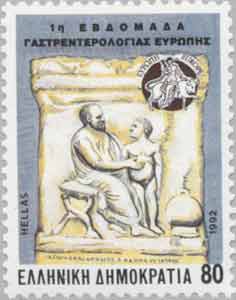
In the first century B.C., Greek physician Archigenes('Αρχιγενης) tried to cure certain hearing disorders by blasting loud noises through a tube. It was thought that fluids from the brain would build up in the ears (almost true).

The Greek physician Galen of Pargamon applied liquids that would dissolve thick fluids while administering medications that would cause patients to lose water from their bodies. Today when know that fluids can collect in the ear for many reasons, but most commonly due to infections, allergies, or impaired drainage.

Ear trumpets were first used by sailors to communicate over long distances, then in the 17th century, they became common assistive devices for the hearing impaired.

Inventor of the telephone, Alexander Graham Bell became interested in sound and sound amplification at an early age because of his speech instructor father (invented 'Visible Speech') and hearing-impaired mother (a talented painter and apparently pianist!). Alexander himself went on to become a teacher of the deaf and married a deaf woman.

He attributes his breakthrough in the design of the telephone as being due to a mistake he had made when trying to decode research article written in German - he mistakenly believed the researchers had been able to transmit vowel sounds over a wire. He would later recall : "If I had been able to read German, I might never have begun my experiments in electricity!"

Bells' tips to young would-be inventors: "Leave the beaten track occasionally and dive into the woods. Every time you do so you will be certain to find something that you have never seen before. Follow it up, explore all around it, and before you know it, you will have something worth thinking about to occupy your mind."

Do you need to review your anatomy of the middle and inner ear? If so, check out this Interactive Ear site. Ear bones are small!

Could you be a surgeon who operates on the ear? If so, take a look at this Ear Movie that shows how a tendon from a muscle behind the ear can be used to make a new tympanic membrane or "ear drum." It's a little amazing that it works as well as it does...Would you like to have been the first person who had this surgery?

Today research scientists are able to study the cellular and molecular basis of hearing. Using the scanning electron microscope, researchers can look and delicate structures that make up the hair cells (convert sound waves into electrical signals).

The ear hears when sound comes into the ear canal, vibrates the tympanic membrane, moves the three ear bones, which in turn pass the vibrating signal to the cochlea where a fluid waves activates hair cells.

Bioengineers have made cochlear implants that can allow some deaf people to hear by stimulating the auditory nerves.


Some deaf communities have asked whether cochlear implants should be given to all people, though, because of concern that this innovation could eliminate deaf culture.

Today, neuroscientists and audiologists are also using computer-based training programs to improve hearing by "training the brain" while other groups are trying silicon chips and micromachining to design more sensitive and accurate artificial ears.

References:
Ancient Greek Physician Stamp
Biography of Alexander Graham Bell
History Hearing Disorders
Ear Trumpets
Visible Speech
Alexander Graham Bell at American Memory
How the Ear Works
Alexander Graham Bell

Previous Latin Sayings of the Week

"Soli deo gloria." - For the glory of God alone.


Christus resurrexit! Vere resurrexit! - Christ is Risen! He is risen, indeed!


"Lex malla, lex nulla." - St. Thomas Aquinas
(A bad law is no law.)


"Cantantes licet usque (minus via laedit) eamus. " - Let us go singing as far as we go: the road will be less tedious.


"Caelitus mihi vires." - My strength is from heaven.

"Magnificat anima mea Dominum, et exsultavit spiritus meus in Deo Salvatore meo" - My soul doth magnify the Lord, and my spirit hath rejoiced in God my Savior (Luke 1:45)

In Omnibus Ipse Primatum Tenens “That in all things He (Christ) might have the preeminence.” (Colossians 1:16-18)


"Qui bene cantat bis orat." - He who sings well, prays twice - (St Augustine)

"Nos fecisti ad te et inquietum est cor nostrum donec requiescat in te." -
Thou hast made us for Thyself, O Lord, and our hearts are restless until they rest in Thee. (St Augustine)

"Caelitus mihi vires
." - My strength is from heaven.

"Ubi caritas et amor Deus ibi est." - Where there is charity and love, God is there.

"Nisi credideritis, non intelligetis ."

Unless you will have believed, you will not understand. - St Augustine

"Deo vindice" - With God as Protector


"Credite amori vera dicenti." - Believe love speaking the truth. (St. Jerome)


De vitiis nostris scalam nobis facimus, si vitia ipsa calcamus." - If we tread our vices under feet, we make them a ladder to rise to higher things. (St. Augustine)

Dei gratia - By the grace of God

Verbum Domini Manet in Aeternum. - The Word of the Lord Endures Forever.

"Est autem fides credere quod nondum vides; cuius fidei merces est videre quod credis." - Faith is to believe what you do not see; the reward of this faith is to see what you believe. (St. Augustine)

"Deo iuvante" - with God's help

"Ut In Omnibus Glorificetur Deus." - That God may be glorified in all things

"Pax vobiscum." Peace be with you.

"Jubilate Deo." Be joyful in the Lord.

"Ille vir, haud magna cum re, sed plenus fidei." He is a man, not of ample means, but full of good faith.

"Facit enim mihi magna qui potens est." - For He that is mighty does to me great things.

"Oremus semper pro invicem." - Let us ever pray for each other.

"Distrahit animum librorum multitudo." - Seneca
A multitude of books distracts the mind.

"Nullam est nunc dictum, quod sit non dictum prius." - Terence
There is nothing said now, that has not been said before.

"Nosce te ipsum." - Plato
Know thyself.

"Non mihi, non tibi, sed nobis" - Not for you, not for me, but for us.

"Primum non nocere." - First, do no harm (Hippocrates)

"Est autem fides credere quod nondum vides; cuius fidei merces est videre quod credis." - Faith is to believe what you do not see; the reward of this faith is to see what you believe. (St. Augustine)

"Deo iuvante" - with God's help

"Ut In Omnibus Glorificetur Deus." - That God may be glorified in all things

"Pax vobiscum." Peace be with you.

"Jubilate Deo." Be joyful in the Lord.

"Ille vir, haud magna cum re, sed plenus fidei." He is a man, not of ample means, but full of good faith.

"Facit enim mihi magna qui potens est." - For He that is mighty does to me great things.

"Oremus semper pro invicem." - Let us ever pray for each other.

"Distrahit animum librorum multitudo." - Seneca
A multitude of books distracts the mind.

"Nullam est nunc dictum, quod sit non dictum prius." - Terence
There is nothing said now, that has not been said before.

"Nosce te ipsum." - Plato
Know thyself.

"Non mihi, non tibi, sed nobis" - Not for you, not for me, but for us.

"Primum non nocere." - First, do no harm (Hippocrates)

"Dei plena sunt omnia." - Cicero (All things are full of God.)