Showing posts with label math. Show all posts

Wednesday, May 21, 2008

Math in Books and Film

In Arthur Conan Doyle's The Musgrave Ritual, Sherlock Holmes uses geometry to solve a 250 year mystery:

"Well, at least I knew that if Brunton could do it, I could also. Besides, there was no real difficulty. I went with Musgrave to his study and whittled myself this peg, to which I tied this long string with a knot at each yard. Then I took two lengths of a fishing-rod, which came to just six feet, and I went back with my client to where the elm had been. The sun was just grazing the top of the oak. I fastened the rod on end, marked out the direction of the shadow, and measured it. It was nine feet in length.

"Of course the calculation now was a simple one. If a rod of
six feet threw a shadow of nine, a tree of sixty-four feet would
throw one of ninety-six, and the line of the one would of course be the line of the other."

Of course, this is an old idea, and how Thales measured the height of Egyptian pyramids some 500 years B.C. For more Math at the movies, check out Mathematics in Movies (includes clips) and Math In the Movies or Mathematical Fiction for books.


Sherlock Holmes image from Wikimedia

Monday, December 3, 2007

Snowflake Templates, Snow Crystals

It's that time of year again! Here are some of our favorite sites for enjoying the beauty of snowflakes, reading about the science and mathematics of their formation, and making your own to put up on the window or Christmas tree.

Snowflake Templates at Yarn Owl
More Snowflake Patterns

For more Snowflake Study consider Koch Snowflake (Fractal) and the beautiful Snow Crystals site.

Do you know where the saying about no two snowflakes are alike came from? The research of a self-educated Vermont farmer who became fascinated by the beauty of snow crystals.

"Under the microscope, I found that snowflakes were miracles of beauty; and it seemed a shame that this beauty should not be seen and appreciated by others. Every crystal was a masterpiece of design and no one design was ever repeated., When a snowflake melted, that design was forever lost. Just that much beauty was gone, without leaving any record behind."

We have both the Caldecott medal winner Snowflake Bentley and the book which contains many of his original photographs Snow Crystals.


If you freeze a piece of black velvet, it keeps individual snowflakes long enough so that you can see their individual details more clearly.

Monday, September 10, 2007

Classical Donald Duck in Mathemagic Land

Ok, this is knowledge-light, but it was recommended by our kids to post on this Classical School Blog. Watch the Youtube.com video Donald Duck in Mathemagic Land. I still vividly remember watching this in my math class with Mr. Timmons in the 7th grade.

There are a few classic math jokes (e.g. square roots) and math tidbits from antiquity (like the secret Pythagorean society).

Wednesday, June 13, 2007

Ancient, Modern, and Fantasy Maps: Ptolemy, GPS, and Tolkien


Lots of people love old maps. A 500 BC map, the Soleto Map was recently unearthed in southern Italy.

We have a special fondness for Ptolemy and his geography. His original maps don't exist, but he was rediscovered in the 1300's, and maps were made based on his descriptions in text. The beautiful map below is based on Ptolemy's coordinate system (before Descartes!). Ptolemy's maps would influence navigation for 1500 years, but his inaccuracies about the Earth's circumference (Eratosthenes was closer) were thought to be responsible for Columbus' underestimate of the time it would take to sail around the world.


Maps are often an essential feature of many tales of fantasy and mythology. J.R.R. Tolkien used map throughout his books to make his worlds more vivid and his son Christopher illustrated many maps like the one below.


If you have spatially-gifted kids, they may love to explore the History of Cartography, as well as the high tech combination Google Earth / NASA plus sites like Flash Earth. GPS / GIS technology has excited today's students about Modern Cartography and some may consider cartography as a career.

If you have GPS, a fun summer activity is Geocaching with the kids. Here's another site with ideas for geocaching with your family and the official Global GPS Cache Hunt Site.

References:
Mathematics and Maps pdf
Ptolemy and his Maps at Wikipedia
Ptolemy's Works at the Vatican
Tolkien and Maps Cliff Notes Lord of the Rings

Tuesday, May 22, 2007

Ancient Egypt: Puzzles, Pyramids, and Math Papyri

A French architect thinks he's solved the mystery of how the Great Pyramid of Giza was built. At an elaborate 3D visualization site (Pyramid of Khufu), Jean-Pierre Houdin shows how he thinks the pyramid was built with a combination of an external ramp and a spiraling internal ramp.

"The crucial piece of evidence in support of an internal network of spiral tunnels comes from a microgravity test carried out in 1986, he said. French scientists found a peculiar anomaly - a less-dense structure in the form of a spiral within the pyramid.
"They had it in the drawer for 15 years because it could not be explained. But when we put my drawings over it, there it was," M. Houdin said. "It is strong evidence, but not proof, that the tunnels still exist inside the pyramid and that they were not filled in," he said."

The Great Pyramid of Khufu at Giza is the only remaining Seven Wonders of the World as listed by the Greek historian Herodotus. Not all of its mysteries have been solved, though. At Who Built the Pyramids and Why?, read more about the mathematical wonders in the detailed design of this pyramid. Excerpt:

"It consists of a line drawn from North to South which is a mere three minutes and six seconds deviant from the celestial meridian which means that the Pyramid was built to face true North. The measurements are staggering. Its base length is 230m 36 cm 4mm. And the circumference is 921m 45cm 6mm. In other words, if we consider a circle with a radius of the Pyramid's height, they will be identical. This speaks to the geniusness of the ancient Afrikans in the B.C. era.

If we multiply the length of the side of the Pyramid by 2 and divide the result by the height, the answer will be 230. 364 multiplied by 2 and divided by 146.599 equals 3.14 which is the modern day Pi, that is, the ratio of the circle's circumference to its diameter contained in the Pyramid. This degree of accuracy proves that the ancient Afrikans- Kemites were well aware of the spherical nature of the earth. They possessed this advanced knowledge of mathematics. They had already calculated the radius and circumference of the earth."

When the Rhind papyrus' hieroglyphics were finally deciphered in 1842, archeologists were surprised discover many math puzzles written on the 18 by 1 foot long papyrus now known as the Rhind papyrus. One puzzle is very similar to the St. Ives puzzle:

"One of these is: Seven houses contain seven cats. Each cat kills seven mice. Each mouse had eaten seven ears of grain. Each ear of grain would have produced seven hekats of wheat. What is the total of all of these?"

The St Ives puzzle: "As I was going to St. Ives, I met a man with seven wives. Every wife had seven sacks, and every sack had seven cats, every cat had seven kittens. Kittens, cats, sacks, and wives, how many were going to St. Ives?"

The answer to the first is 19,607. The answer to second is 2800 going to St. Ives.

The Nile Valley may have been the birthplace of algebra and trigonometry, but unlike the mathematical abstract philosophers of ancient Greece, the ancient Egyptians had more practical uses for their math in business and building (of course!).

Does your head hurt from all these calculations? Maybe you should take a break by playing this Mummy Maker Game at BBC History.

Here you can Write Your Name in Egyptian Hieroglyphs.


Reference Links:
Fox News: Houdin and the Great Pyramid
Independent: Khufu Pyramid
Inside the Pyramid
PBS: Travel Into the Pyramid
Rhind Papyrus

Monday, May 14, 2007

Ancient Mathematics and Science: The Circle and Navigating by the Stars

"Oak and triple bronze must have girded the breast of him
who first committed his frail bark to the angry sea."
--Horace, Odes

In this ancient Babylonian map, the world is a circle with Babylon at its center. Ancient Babylonians were the first to divide the circle into 360 degrees (how we also got our 60 min / 60 sec clocks), and they may have been among the first to use the wheel.

As it turns out circular divisions were an important tool for sea explorations, and they were essential for the growth of many ancient civilizations. Read the student links at this Navigating by the North Star lesson plan. Because of its location, the North Star is a reliable landmark that can be used for determining one's location on the earth.

The bottom figure at left shows a photograph taken with the shutter left open. The "star swirl" occurs because the other constellations rotate around the fixed position of the North Star over the course of the evening.

Read about How a Sextant Works and build one here.

Would you know how to use it to determine your latitude? If you have an accurate clock set to Greenwich Mean Time, you can also calculate your longitude.

If you have Shockwave, you can play this game Escape from Antartica and see if you can find your way home like Ernest Shackleton.

Tuesday, April 24, 2007

Ancient Greeks: Pythagoras, Mathematics, and Music

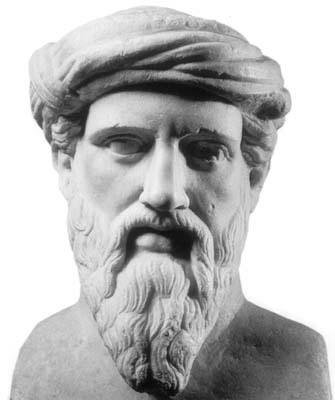
Pythagoras of Samos was a Greek philosopher and mathematician who also founded a mystical relgious movement called Pythagoreanism. He is best known for his Pythagorean theorem which states:

In any right triangle, the area of the square whose side is the hypotenuse (the side of a right triangle opposite the right angle) is equal to the sum of areas of the squares whose sides are the two legs (i.e. the two sides other than the hypotenuse).
The truth is, though, Pythagoras may have picked up this proof on his travels to Asia, as this proof was well known among mathematicians there. For more on the Chinese proof, click here.

The Pythagorean School was a secretive society and so many details are not known, but some rules of the Pythagoreans included strict vegetarianism, prescriptions about silence, incense, picking up what had fallen, physical and moral purification, and a belief that "Everything that exists is a number." In around 400 B.C., the discovery of irrational numbers upset the Pythagoreans.

Pythagoras is also famous for his interest in the Music of the Spheres.

Using a stretched string on a movable bridge, Pythagoras discovered that there were certain intervals that pleased peoples' ears: an octave (1:2), fifth (2:3), and fourth (3:4).

To listen to what these different intervals sound like, check out Harmony and Proportion. More on musical intervals on the guitar and Pythagoras are here.

For younger kids, print out and read this excellent book chapter on Pythagoras and his followers.

More Resources
Listen to Samples of The Music of Ancient Greece
The History of Music
Pythagoras picture

Monday, April 16, 2007

Ancient Greeks: Thales - Scientist, mathematician, philosopher, businessman


Thales of Miletus is often referred to as the father of science, the father of philosophy, and the father of geometry. He was a very clever man, and sought to understand the world through a study of its patterns, rejecting explanations from mythology.

We just discovered Julie Diggins' String, Straight-Edge, and Shadow, and here you can read its Thales Chapter. Among Thales' apparent accomplishments: predicting an eclipse in 585 B.C., successfully predicting a bountiful harvest of olives after several bad seasons (he was certain, he also cornered the market on olive presses beforehand, and made a great deal of money), measuring the height of Egyptian pyramids by "shadow reckoning", a strategy for measuring the distance of a ship at sea, five propositions (with proofs) of plane geometry, a theory of earthquakes (movement of land because it floated on water).


Of course, Thales was also wrong about many things (for instance, he thought all things were composed of water and that magnets (lodestones) had souls), but he inspired many generations of scientists, mathematicians, and philosophers to look for the patterns, rules, and relationships that existed in the natural world.

References:
Math Story / Lesson: On Thales
Wikipedia: Thales
Thales at the Internet Encyclopedia of Philosophy
The Life and Accomplishments of Thales of Miletus
Ancient Greeks

Friday, March 23, 2007

Classical Homeschooling: Backing Our Way into Physics


I want to teach my kids to be good natural scientists. Physics always seemed to be a natural science to introduce early (even toddlers negotiate their physical world), but it's easier wished than done.

I remember Richard Feynman's writing about how his father first told him about physics principles from The Pleasure of Finding Things Out, " said, 'Say Pop, I noticed something: When I pull the wagon the ball rolls to the back of the wagon, and when I'm pulling it along and I suddenly stop, the ball rolls to the front of the wagon," and I says, 'why is that?' And he said, 'That nobody knows,' he said. 'The general principle is that things that are moving try to keep on moving and things that are standing still tend to stand still unless you push on them hard.' And he says, 'This tendency is called inertia but nobody knows why it's true.'" I like that approach because it gives knowledge with an appreciation for what also is unknown. But the problem is me. I also wish I knew as much about Nature as Anna Comstock (Handbook of Nature Study, but our natural teaching moments were more likely to be planned or science-lite, relying on what knowledge I happened to have available without looking it up in a book.

Physics is a tricky subject to teach for tweens or middle school students because it doesn't have to be as complex or rigorous as high school or college prep physics, but it also deserves more than elementary school level explanations. I had started off this year with the high school Conceptual Physics book, and we even spent some time with Conceptual Physical Sciences, but although our son could read the chapters and answer the questions, it wasn't helping him look at his natural surroundings more thoughtfully or think like a scientist. And it seemed a lot like work, rather than something that was intriguing or fun.

Recently we found this delightful site that has free online Classical Physics demonstrations. It's not enough to be a stand-alone curriculum, but it terrific for bring back the fun.

Though we covered Newton's Laws of Motion, we're now revisiting what we've learned, so that understand more about the historical context that drove Newton connect ideas about the movement of the planets, with movement on earth. In order to answer his questions in a specific way, had had to develop a new branch of mathematics (calculus) to test hypotheses about what laws could predict movement.

Newton's laws would allow others to design rockets, spaceships, and rollercoasters, predict the movements of golf balls, fluids, and neutrons in a nuclear reactor. As we collect links and for study notes, we'll post them on our blog.

I'm much happier with our current track in physics because I can see our children's curiosity and excitement returning, and they're getting a better experience for what the practice of science is - observing carefully, questioning, hypothesizing, making conclusions, and then recognizing what remains unknown.

BTW, the beautiful pictures above are from that wonderful MIT physicist and teacher, Harold Edgerton, who was able to stop time and provide surprising insights into the behaviors that previously were too fast to study.

Edgerton Golf Picture
Harold Edgerton Center
Edgerton Explorit Center
High Speed Visualization Lab...Cool Pictures

Technorati tags: , , , ,

Thursday, March 1, 2007

Surprise Snow - Aristotle, Mathematics, and Weather Prediction


I was going to blog on something else, but we had a surprise hail and snowstorm (?? in Seattle??- see some branches outside our window -->) so a change in plan!

There was no warning at all about this storm. How can we have such sophisticated technology, but miss something as big as this (our area is a confluence zone so we may get 4 to 6 inches)? Even Aristotle brooded about his failure to understand the patterns of weather: "But we must go on to collect the facts bearing on the origin of it, both those which raise no difficulties and those which seem paradoxical. Hail is ice, and water freezes in winter; yet hailstorms occur chiefly in spring and autumn and less often in the late summer, but rarely in winter and then only when the cold is less intense..."

Supposedly the Seattle area is particularly difficult to predict for snow and fog (Snow, Who Knows), so there are plenty of future research opportunities for budding weather or atmospheric scientists. On a different note, see how a mathematician used crocheting to realize a weather pattern based on Lorenz equations here.

Aristotle's Metereologica
Weather Forecasting Through the Ages
Mathematicians and the Weather
The Numbers Guy - Grading Weather Forecasts
Hailstone Pictures
Weather Map Lesson Plan at Discovery.com
Eide NL Blog: Snow Crystals and Snowflake Links

Technorati tags: , , , , , , ,

Previous Latin Sayings of the Week

"Soli deo gloria." - For the glory of God alone.


Christus resurrexit! Vere resurrexit! - Christ is Risen! He is risen, indeed!


"Lex malla, lex nulla." - St. Thomas Aquinas
(A bad law is no law.)


"Cantantes licet usque (minus via laedit) eamus. " - Let us go singing as far as we go: the road will be less tedious.


"Caelitus mihi vires." - My strength is from heaven.

"Magnificat anima mea Dominum, et exsultavit spiritus meus in Deo Salvatore meo" - My soul doth magnify the Lord, and my spirit hath rejoiced in God my Savior (Luke 1:45)

In Omnibus Ipse Primatum Tenens “That in all things He (Christ) might have the preeminence.” (Colossians 1:16-18)


"Qui bene cantat bis orat." - He who sings well, prays twice - (St Augustine)

"Nos fecisti ad te et inquietum est cor nostrum donec requiescat in te." -
Thou hast made us for Thyself, O Lord, and our hearts are restless until they rest in Thee. (St Augustine)

"Caelitus mihi vires
." - My strength is from heaven.

"Ubi caritas et amor Deus ibi est." - Where there is charity and love, God is there.

"Nisi credideritis, non intelligetis ."

Unless you will have believed, you will not understand. - St Augustine

"Deo vindice" - With God as Protector


"Credite amori vera dicenti." - Believe love speaking the truth. (St. Jerome)


De vitiis nostris scalam nobis facimus, si vitia ipsa calcamus." - If we tread our vices under feet, we make them a ladder to rise to higher things. (St. Augustine)

Dei gratia - By the grace of God

Verbum Domini Manet in Aeternum. - The Word of the Lord Endures Forever.

"Est autem fides credere quod nondum vides; cuius fidei merces est videre quod credis." - Faith is to believe what you do not see; the reward of this faith is to see what you believe. (St. Augustine)

"Deo iuvante" - with God's help

"Ut In Omnibus Glorificetur Deus." - That God may be glorified in all things

"Pax vobiscum." Peace be with you.

"Jubilate Deo." Be joyful in the Lord.

"Ille vir, haud magna cum re, sed plenus fidei." He is a man, not of ample means, but full of good faith.

"Facit enim mihi magna qui potens est." - For He that is mighty does to me great things.

"Oremus semper pro invicem." - Let us ever pray for each other.

"Distrahit animum librorum multitudo." - Seneca
A multitude of books distracts the mind.

"Nullam est nunc dictum, quod sit non dictum prius." - Terence
There is nothing said now, that has not been said before.

"Nosce te ipsum." - Plato
Know thyself.

"Non mihi, non tibi, sed nobis" - Not for you, not for me, but for us.

"Primum non nocere." - First, do no harm (Hippocrates)

"Est autem fides credere quod nondum vides; cuius fidei merces est videre quod credis." - Faith is to believe what you do not see; the reward of this faith is to see what you believe. (St. Augustine)

"Deo iuvante" - with God's help

"Ut In Omnibus Glorificetur Deus." - That God may be glorified in all things

"Pax vobiscum." Peace be with you.

"Jubilate Deo." Be joyful in the Lord.

"Ille vir, haud magna cum re, sed plenus fidei." He is a man, not of ample means, but full of good faith.

"Facit enim mihi magna qui potens est." - For He that is mighty does to me great things.

"Oremus semper pro invicem." - Let us ever pray for each other.

"Distrahit animum librorum multitudo." - Seneca
A multitude of books distracts the mind.

"Nullam est nunc dictum, quod sit non dictum prius." - Terence
There is nothing said now, that has not been said before.

"Nosce te ipsum." - Plato
Know thyself.

"Non mihi, non tibi, sed nobis" - Not for you, not for me, but for us.

"Primum non nocere." - First, do no harm (Hippocrates)

"Dei plena sunt omnia." - Cicero (All things are full of God.)