
Our son had a great time in the Molding Your Pose course from ScholarsOnline.org.
The assignments:
1. Retell a myth or folktale in 150 words or less
2. Retell the same story in 50 words or less.
3. Retell the story as a newspaper article. Less than 500 words.
4. Retell the story from the first person perspective. Less than 500 words.
5. Retell the story with attention to the sounds of words. Less than 500 words.
6. Retell the story with humor. Less than 500 words.
7. Free choice. Our son chose a courtroom drama.
---
Our son chose the myth of Icarus. This assignment is practice for Logic or Rhetoric students who should be analyzing, imitating, and
1. Icarus in 150 words or less
In ancient Greece, Daedalus the inventor built a large Labyrinth for King Minos of Crete. However, King Minos, in a fit of anger, trapped Daedalus and his son Icarus in a tower. To escape, Daedalus made wings of feathers and wax. Daedalus warned Icarus that flying too close to the Sun would make his wings melt. They flew from the tower. Icarus, excited by flying, flew towards the Sun. The Sun melted his wings, Icarus fell into the sea, and drowned. Daedalus mourned the loss of his son, and to this day the sea into which Icarus fell has been known as the Icarian Sea.
---
2. Icarus in 50 words or less.
A man is imprisoned in a tower with his son. To escape, he makes wings. He warns the wings could melt too close to the Sun. The two depart. The man's son, excited by flying, flies towards the Sun. His wings melt, and he falls and drowns. His father mourns.
---
3. Icars as a newspaper article. Less than 500 words.
SON OF FAMOUS CRAFTSMAN DROWNS IN FREAK ACCIDENT
By Androcles
In a daring escape attempt, Icarus, son of renowned craftsman Daedalus, has died after plunging nearly 250 feet into the Aegean Sea. The 16-year-old boy tried to fly with a pair of makeshift wings made of wax and feathers, but the wax was melted by the heat of the Sun, and Icarus fell into the sea.
Erasmus, a fisherman at the time of the incident, says, "I was sitting there, fishing, and then I heard a bloodcurdling shriek. I looked up, and saw what looked like an enormous hawk, feathers flying in every direction. It fell towards me and I saw it was a human being."
According to Daedalus, he and the boy were imprisoned in a tower by King Minos of Crete. Court watchers disagree on whether King Minos imprisoned the two because of Daedalus's role in creating the Labyrinth or for some other motive. Daedalus refused to elaborate. Daedalus and his son escaped by making wings from wax and bird feathers found in the tower. He warned Icarus not to fly too close to the Sun. Shortly after the two took off, Icarus flew up towards the Sun, despite his father's repeated warnings. As he flew higher, his flight patterns became erratic, and feathers started falling off. Within minutes, Icarus plunged into the sea and drowned.
Demetrius, Icarus's tutor, says, "Icarus was bold, he was daring, he took risks. He was the first man to fly near the Sun. He was a remarkable lad. All of Greece should be proud of him."
Services will be held at the Temple of Apollo at 2:30 PM next Monday.
4. Icarus from the first person perspective. Less than 500 words.
Our loyal subjects, your king has heard some slanderous rumors of the craftsman Daedalus and the death of his son. Daedalus and Icarus of Crete were traitors to our country and they showed contempt towards the gods. They should not be treated as heroes of Greece, but rather as villains whose memories should be scorned.
One year ago, the Labyrinth was built to hold our stepson, the Minotaur. Only the builder, Daedalus, knew how to leave the Labyrinth, and it was learned he betrayed the secret to the Athenians. As many of you know, an Athenian, Theseus, recently murdered our stepson. Our grief has been great.
We could have had Daedalus and his son put to death immediately, but instead we chose to spare their lives. Rather than being grateful for our mercy, they chose to injure one of our palace guards and defy Mount Olympus. As we were descending the stairs of the Great Tower, we heard scuffling above us. We returned to see Icarus and Daedalus leaping off one of the highest floors. They wore crudely-fashioned wings of feathers and wax stolen from the palace grounds. Daedalus was shouting at his son, who was soaring too close to the Sun. Lord Apollo himself was offended by this brazen display, and he struck Icarus down from the sky.
5. Retell Icarus with attention to the sounds of words. Less than 500 words.
In days of old, the inventor Daedalus held the key
To King Minos' most urgent plight.
The monstrous Minotaur, mighty man-bull,
Threatened all of Crete.
Minotaur feasted on human flesh
Snorting, slobbering, shredding
Bellowing, booming, baying.
The earth thundering under his hooves.
Walls, trees, and houses quaking with every rage.
Finally a magnificent Labyrinth was made.
A tangle of twisting paths,
Bewildering blind alleys
At last restrained the beast.
Minos,
Cruel and corrupt,
Conceived a clever crime.
The inventor and his son were shackled
To keep the secret safe.
In a dank and grim prison tower
Daedalus and Icarus sat.
Dark, dismal, desperate.
Suddenly, a plan!
A flapping flurry of wings outside the window.
"I shall make some wings
So that we can escape this horrible place."
Daedalus and Icarus began to scrounge
For feathers from birds
Wax from the candle drippings left by the jailers.
Daedalus rubbed the wax roughly between his fingers.
At last they were finished.
Drawing close to his son,
Daedalus sternly warned,
"Do not fly too high. The Sun will melt your wings."
They squeezed through the bars of their cell.
They looked down at the green-blue ocean
With torrents of white foam crashing on the rocks below.
They were whipped by wild winds.
The two jumped off the edge.
Time stopped.
It looked as if they would plummet into the sea.
But they forced their wings together and swept up to the heavens.
Then Icarus felt a terrible change.
A drop on his shoulder.
He turned his head.
The wings were beginning to melt.
Suddenly feathers were flying off everywhere.
He silently screamed.
Daedalus saw his son plunge into the sea.
6. Retell Icarus with humor. Less than 500 words.
"Can I help you?"
"Sure. Where am I anyway?"
"In Tartarus."
"Tartarus?! What do you mean? I don't belong here!"
Icarus looked around. It was hard for him to see anything at first. A strong suffocating smell choked his lungs. Fire crackled around him. He was struggling to fly out of a river of tar with two wings strapped to his arms.
"I'm sorry, but I'm not in charge of the place. What happened to you, anyway?" a bearded old man asked, straining to push a giant boulder up a cliff.
"It was all Dad's fault. The King got mad at Dad so he put him in jail. I don't blame him; he always wants to be in charge. I guess it was because of that big maze he built. That was awesome. But the old king said he was 'a danger to the people of Crete' or something like that, which is crazy. I didn't do anything. I have no idea why he put me in jail."
Upon hearing the word "jail", the bearded man eyed Icarus suspiciously and said, "Well, I'm pretty busy. Excuse me, I have to get this boulder up the mountain."
"We were innocent!" Icarus shouted. "As I was saying, Pops and I were put in jail-- unfairly-- so he made some wings from some stuff around the room. My old man punched out some guards and the two of us flew away. I saw Dad was about to fly into a flock of seagulls, so I was trying to draw them away, but then all of a sudden my wings melted and I fell into the sea! Dad never warned me about that!"
After Icarus finished his story, the bearded man went back to pushing the boulder up the cliff.
"Er, weren't you supposed to help me?" Icarus asked. "Hello? I'm kinda stuck here. Help me? Please?"
Icarus sighed. There seemed to be no hope of getting out of this place.
Just then, the bearded old man came running down the side of the cliff and reached out towards Icarus.
Soon afterwards, the boulder rolled down the mountain and into the sea, where it landed on Icarus. While he struggled to get up, he heard the old man's voice shouting, "Sorry about that."
7. Retell Icarus as a courtroom drama.
The courtroom was hushed. Daedalus was on trial for his life. The prosecutor, Baltsaros, paced in front of the witness.
"Daedalus, is it true that you planned and commanded that the deceased, Icarus, use wax wings to flee the palace grounds at Crete?"
"Yes, but---"
"And is it true that the decision to use wax wings caused the untimely death of Icarus?"
"Yes."
Daedalus groaned. A member of the jury sighed in sympathy, to which the judge replied, " As jurors, be aware you are not to be swayed by sympathy."
Baltsaros continued.
"Did you realize that the wax in the wings you made would melt after intense exposure to the Sun?"
"Yes."
"Let it be known, gentlemen of the jury, that the immediate cause of Icarus' death was the melting of wax wings, resulting in his plunging to his death from a height of approximately 500 feet. No further questions, your honor."
Daedalus looked around anxiously. Daedalus's defense attorney, Adeipho, stood up. He was a tall, stately looking man, with dark hair and hollow cheeks.
"Daedalus, is it not true that you loved your son, and would never intentionally try to kill him?"
"Yes. We were trapped, and our lives were in danger. The experience was destroying Icarus from the inside out. There was no other way." By this point, Daedalus had broken into a cold sweat, which caused several members of the jury to look concerned.
"Daedalus, isn't it true that you made several attempts to warn Icarus about not flying too close to the Sun?"
"Yes. I told him. He knew it. I don't know why he flew so high. Maybe he lost track of how high he was flying. Maybe the winds pushed him up."
"Objection! This is pure speculation, your Honor," shouted Baltsaros.
"Objection sustained," the judge sternly replied, banging his gavel.
Daedalus looked relieved.
Adeipho looked up at the judge and said, "No further questions, your Honor."
"Baltsaros, would you like to cross-examine the witness?"
Baltsaros smirked and rose to his feet.
"Yes, your Honor. Daedalus, isn't it true that you knew Icarus had shown some rather rash judgment in the past?"
"No. What do you mean?"
"Isn't it true that Icarus jumped off the roof of the Temple of Apollo on a dare?"
"Yes, but--"
A gasp went up among the courtroom spectators.
"But he was just a young--"
"Just answer the question. Yes or no?"
"Yes."
"Gentlemen of the jury, even though Daedalus knew of Icarus' rash decisions in the past, he still decided to give him the instruments of his death. Therefore, you must find him guilty of involuntary manslaughter."
"Objection sustained."
The two attorneys made summary arguments to the jury. The jury recessed for hours. At last they returned.
"Members of the jury," asked the judge, "have you arrived at a decision?"
The foreman stood and shouted, "We find the defendant, Daedalus, innocent of all charges."
Daedalus cried tears of joy. He was free at last.
Showing posts with label ancient greece. Show all posts
Showing posts with label ancient greece. Show all posts
Sunday, May 29, 2011


Tuesday, June 16, 2009
Revealing the Parthenon's True Colors
Using a very sensitive technique, archeologists have been able to find traces of residual paint on figures within the Parthenon, like Egyptian Blue on the belt of Poseidon. 

Parthenon's hidden color


Parthenon's hidden color
Wednesday, May 21, 2008
Math in Books and Film
 In Arthur Conan Doyle's The Musgrave Ritual, Sherlock Holmes uses geometry to solve a 250 year mystery:
 "Well, at least I knew that if Brunton could do it, I could also. Besides, there was no real difficulty. I went with Musgrave to his study and whittled myself this peg, to which I tied this long string with a knot at each yard. Then I took two lengths of a fishing-rod, which came to just six feet, and I went back with my client to where the elm had been. The sun was just grazing the top of the oak. I fastened the rod on end, marked out the direction of the shadow, and measured it. It was nine feet in length.
"Of course the calculation now was a simple one. If a rod of
six feet threw a shadow of nine, a tree of sixty-four feet would
throw one of ninety-six, and the line of the one would of course be the line of the other."
 Of course, this is an old idea, and how Thales measured the height of Egyptian pyramids some 500 years B.C. For more Math at the movies, check out Mathematics in Movies (includes clips) and Math In the Movies or Mathematical Fiction for books.
Sherlock Holmes image from Wikimedia
Tuesday, April 22, 2008
Writing a Socratic Dialogue

Our son's just finishing his online Logic course through Biola, and after reading Plato's Meno, the students were asked to write a Socratic dialogue on any topic of their choice. This assignment is a perfect cap to a logic course; I also can't help thinking it will make him more successful at being able to analyze the arguments of others and persuade some to his own opinions when important topics (different philosophies, religious beliefs, social or political opinions) are being considered.
Wikipedia describes the Socratic method as "a negative method of hypotheses elimination, in that better hypotheses are found by steadily identifying and eliminating those which lead to contradictions. The method of Socrates is a search for the underlying hypotheses, assumptions, or axioms, which may subconsciously shape one's opinion, and to make them the subject of scrutiny, to determine their consistency with other beliefs. The basic form is a series of questions formulated as tests of logic and fact intended to help a person or group discover their beliefs about some topic, exploring the definitions or logoi (singular logos), seeking to characterize the general characteristics shared by various particular instances."
Some common features of a Socratic dialogue (from Peter Kreeft's Socratic Logic):
1. The goal is moral or philosophical.
2. Define the question and ambiguous terms.
3. Question, rather than giving one's opinion.
4. Examine the why of the discussant's belief, especially looking for ambiguous terms, a false premise, or logical fallacy.
5. Trace premises back to additional premises.
6. Draw out consequences of the belief (reductio ad absurdum)
7. Construct an argument that contradictors the belief.
8. Closure and proof.
Here's an excerpt of our son's Socratic Dialogue. He wanted to address the issue of Free Will. If you'd like the read the entire dialogue, click here.
"Adelphos: Socrates, why do you waste your time by chatting with the people on the street?
Socrates: Ah, Adelphos! What a delightful surprise!. I have waited years for somebody to ask this question. Exactly in what sense am I wasting my time?
Adelphos: You aren't teaching anyone with your little dialogues in a way that can change their fate. Look at Demos there. He is the son of wise Erasmus, and also a wealthy young man of Athens. The gods know the number of his days, and he has inherited the wisdom of his father and the kindness of his mother. Look upon his face, his bearing, his diligence. He will be a fine young man whether he listens to you babble on for hours or not.
Socrates: There are a few questions I want to ask you. First, if the gods know the number of Demos's days, does that necessarily make any action of his futile?
Adelphos: It does not. The good deeds of a good man bring much blessings, whether his life is long or short.
Socrates: And is it always the case that good fathers have good sons?
Adelphos: That is not the case, though there are more good sons that come from good fathers than bad sons that come from good fathers or good sons that come from bad fathers.
Socrates: Exactly what causes the exceptions, particularly when bad sons are born to good fathers?
Adelphos: It depends. Sometimes it's the result of the bad character that's given to the sons by the gods. Sometimes it's the ideas imposed upon the sons by other people that corrupt a naturally good character.
Socrates: How do these ideas get imposed upon the naturally good sons?
Adelphos: From spending too much time listening to the ideas of other people with poor character and imitating their actions. Let me give you an example. Alcibiades was born of a good family and he had plenty in terms of beauty and cleverness, but he turned out bad because he was surrounded by a few reckless and wild people.
Socrates: Yet it would seem to me that if anyone was fated by the gods to be good, Alcibiades was. It looked as if he had many gifts from the gods and blessings from his parents, yet he turned out bad because he imitated the poor judgments and actions of others. Was he simply fated to spend his time with evil friends and so to learn to make bad choices? Or did he choose to do so?
Adelphos: I see where you are going with this, Socrates. But choosing and being fated to choose are the same thing..."
For more examples of Socratic dialogues, check out the Google books excerpts from Peter Kreeft's Socrates Meets Marx
Monday, April 14, 2008
The First Historian: Herodotus of Helicarnassus

The world's first historian was Greek storyteller Herodotus of Helicarnassus. He was a wonderful storyteller, but some critics (from Thucydides to modern historians) have bemoaned his inaccuracies, leading some to call him instead, "The Father of Lies."
What led Herodotus to research and record historical events in such detail, traveling long distances to obtain first-hand accounts of events, then retelling them as stories? It's Herodotus that we owe the credit for the Spartan Dienekes' great line at Thermopylae, "So much the better, then we will fight in the shade."
Because Herodotus enjoyed entertaining others with his stories, he related well-chronicled events as well as hearsay, gossip, and outlandish fables, but even the latter often had some basis in truth. Here a team of explorers recently found evidence that Herodotus' stories of gold-digging ants were ac tually marmots that uncovered gold by the incessant burrowing in the Himalayas. For another Herodotus vindication, check out Herodotus and the Ancient Etruscans.
Wikipedia: Battle of Thermopylae
Monday, March 3, 2008
Building an Ancient Greek Ship - Trireme
The bireme (2 rows of oars) was used during the Trojan Wars, but the trireme would become the ultimate warship in Greece's victory against the Persian fleet at Salamis in 480 B.C.
 Here's more about the history and archeology of the trireme. Click here if you want to find paper templates and rules to re-enact the Battle of Salamis, and here for a very short trireme Youtube video that shows a working trireme at sea.
 Triremes usually 170 rowers arrange in 3 rows. They were very narrow and built for close in battles, rather than long open ocean campaigns. For a great review of the importance of the Trireme at Salamis, read here. The Persians attacked the Greeks, but by the time the battle was over, 200+ Persian boats were lost compared to 40 of the Greeks.
How Triremes Were Made
Kids' Examples: Building Triremes with Popsicle Sticks
 Here's more about the history and archeology of the trireme. Click here if you want to find paper templates and rules to re-enact the Battle of Salamis, and here for a very short trireme Youtube video that shows a working trireme at sea.
  Triremes usually 170 rowers arrange in 3 rows. They were very narrow and built for close in battles, rather than long open ocean campaigns. For a great review of the importance of the Trireme at Salamis, read here. The Persians attacked the Greeks, but by the time the battle was over, 200+ Persian boats were lost compared to 40 of the Greeks.
How Triremes Were Made
Kids' Examples: Building Triremes with Popsicle Sticks
Monday, January 7, 2008
The Fall of Ancient Greek Civilization - The Peloponnesian War

Our son's midterm paper topic (Schola Tutorials) over Christmas break was Who Should Have Won the Peloponnesian War. I confess to knowing very little about the Peloponnesian War, but the topic piqued my curiosity as I remember from some of my friends at Harvard that Thucydides' The History of the Peloponnesian War was mandatory reading for Gov 40, the killer pregov / prelaw course (like the premeds' Organic Chem). So why should this old book be required reading?
We've been wending our way through The Baldwin Project's The Story of the Greeks and I came to realize that there is a lot to learn from this War for any citizen of a democratic country. Athens should have won. It wasted its talented leaders and could not act decisively to unite the different dissenting voices within its city states. Human vices of arrogance, greed, and cruelty, doomed much more than who would rule Greece. I was surprised to learn that most of my son's online classmates felt that the Spartans should have won the war. Certainly this could make for a good discussion or debate over the dinner table!
An excerpt from Gilbert Highet's The Classical Tradition:
"It is not always understood nowadays how noble and how widespread Greco-Roman Civilization was, how it kept Europe, the Middle East, and northern AFrica peaceful, cultured, prosperous, and happy for centuries, and how much was lost when the savages and invaders broke in upon it...We are so accustomed to contemplating the spectacle of human progress that we assume modern culture to be better than anything that preceded it. We forget also how able and how willing men are to reverse the movement of progress: how many forces of barbarism remain, like vocanoes in a cultivated island, still powerfully alive, capable not only of injuring civilization but of putting a burning desert in its place."
----------
For those of you interested in samples of middle school writing, here's our son's short position paper on the War:
Athens should have won the Peloponnesian War.
The Athenians' loss in the Peloponnesian War meant a loss of Greek independence and setback for the principles of democracy throughout the Western world. At the start of the war, Athens had good resources, a superior navy, and a good general in Pericles. Pericles' war strategy was to protect his population behind the Long Walls. Sparta attacked the countryside, but could not significantly harm the people or the supply lines to Athens, which were protected by their fleet. Athens was defeated mainly due to a plague that struck, killing almost one-third of the population, including Pericles.
Sparta ended up winning the war, but ruled poorly over Greece because of poor leaderships and a society that was not oriented toward government during peacetime. Spartan culture emphasized only military strength and denied its citizens individuality and free choice. As a result, Spartan culture had little in the way of the arts or philosophy. Children were taken away from their mothers at age 7 and raised by nurses with little coddling and only simple food. This culture was non-Biblical. Whereas the Bible places importance on the family and the different roles of father, mother, and child, the Spartan culture placed little importance on family, and replaced the family with the state.
As a result of Sparta winning, all the Greek city-states were weakened. As a result, it was easier for Macedonia to conquer them several decades later.
Athens should share some of the blame for losing the Peloponnesian War. Athens went to conquer Sicily and Syracuse, exhausting their navy and army, and making them more vulnerable to defeat. Also, the Athenians had a bad tradition of exiling or killing some of their greatest leaders. Many were so anxious that their leaders would gain too much power and become tyrants that they accused them of crimes that many probably did not commit. Many good leaders may have been killed, exiled, or forced to defect to another country, like Alcibiades.
The Age of Pericles was a time when politics, philosophy, and the arts flourished in Greece. Pericles also created a large number of public works projects that made living easier for the Athenians. If Athens had won the Peloponnesian War, perhaps that age would have continued.
A War Like No Other - NRO
The Plague of Athens
Peloponnesian War Picture
Monday, September 24, 2007
In Search of Historical Troy
 The real story of the discovery of what some archaeologists believe may be Homer's Troy is like an adventure story itself.
As a boy, Heinrich Schliemann became fascinated by his father's reading of the Iliad, so as soon as he was old enough, he set out to discover the lost city of Troy. Despite no formal archaeological training himself (he had only been on one dig before), he managed to excavate the site Hissarlik that some believe today could be the ancient city of Troy. To some archaeologists, he was huckster who was more interested in proving he had found Troy than assessing whether he had; nevertheless, he made some of the greatest finds from Antiquity, and today Hissarlik is the site of Troy VI, the best known candidate site for Troy. Of note, Schliemann would also find remarkable relics at Mycenae including the "Agamemnon's mask" at right. To Schliemann's credit, his documentation and logging of archaeological finds improved over the twenty years of his life's work.
 Some archeologists believe Troy VI is too well fortified to be the Troy of Homer's Iliad, but dating suggests that Troy VI was at least be a city contemporary to the time of Homer's writing.
If you are tempted to see whether any recent Hollywood treatment of the Trojan War is worthwhile, check out Troy's Fallen! for the Archeology Magazine's mournful description of what that reviewer calls a "chronological train wreck." I think we're better off reading a Classic Comic of The Iliad.
This past week we got a board game called Hector and Achilles and it's really fun. We kept getting confused about the names, cities, and events in the Iliad, so this could both help with the people and places, and kick our regular card games up a notch. It's amazing how quickly I got used to cringing when I saw Achilles appear for the Achaens!

In Search of the Trojan War: Greek Art and Archeology
Virtual Reconstructions of Troy
Evidence from Homer about the Site of Troy
Heinrich Schliemann: The "Father" of Modern Archeology
Mask of Agamemnon
Reconstruction of Troy
Saturday, September 15, 2007
Ancient Greece: The Iliad

We've haven't started Koine Greek, but as our son was asked to memorize the opening stanza of the Iliad, we've been talking about translations. If you know Greek, the opening stanza is this:

But look at the dramatic differences in translation.
From Lattimore, assigned by his teacher:
Sing, goddess, the anger of Peleus' son Achilleus
and its devastation, which put pains thousand-fold upon the
Achaians,
hurled in their multitudes to the house of Hades strong souls
of heroes, but gave their bodies to be the delicate feasting
of dogs, of all birds, and the will of Zeus was accomplished...
And from Fagles:
Rage -- Goddess, sing the rage of Peleus' son Achilles,
murderous, doomed, that cost the Achaeans countless losses,
hurling down to the House of Death so many sturdy souls,
great fighters' souls, but made their bodies carrion,
feasts for the dogs and birds,
and the will of Zeus was moving toward its end.
Good translators need to have a deep understanding of both languages, the importance of word order, the associations of particular words in the language and culture, a good understanding of the rhythm and music of different languages (especially for literary and poetical works), as well as over-arching themes.
For interesting practice, check out the first link below which addresses the two translations side-by-side, including worksheet-type practice at word choice and ideas for writing assignments.
The second link shows how high tech is allowing more people to access antiquity - The oldest most complete Iliad (645 page parchment manuscript), only photographed in 1901 because of its delicate condition, is now being scanned in at high resolution in digital form.

The Iliad in Translation - What Difference Does It Make?
Robot Arm Scans Ancient Iliad Manuscript
The Iliad at Wikipedia
Monday, June 4, 2007
Ancient Greece and a Classical Christian Education
Classical Christian schools are undergoing a revival in the United States, jumpstarted from Douglas Wilson's Recovering the Lost Tools of Learning in 1991 and Susan Wise Bauer's The Well-Trained Mind in 1999. Of course, more continuous history of classical Christian education can be traced from classical Catholic educators.
The question of how to incorporate ancient Greek history, mythology, and philosophy often arises between different groups as well as different parents and educators. Here are some reflections from a book I'm reading by Gilbert Highet: "We read them not because they are "historic," but because they teach us, they make us think. Nowhere else in the entire literature of the world, in any language or any single period is there such a rich, varied, and deeply thoughtful collection of books as those produced by the Greeks and their successors the Romans...A wise man of our own time was once asked what was the single greatest contribution of Greece to the world's welfare. He replied "The greatest invention of the Greeks was
 (or "on the one hand") and
  ("on the other hand"). Without these two balances, we cannot think. The Greeks therefore taught one another, by thinking and talking, and writing."
 Highet adds, "One of the chief pleasures of studying aesthetic and intellectual history is to see how their ideas...reappear in distant times...If we open Dante's Comedy...we recognize the moral system of the Greek philsopher Aristotle. If we see Shakespeare's Macbeth, we reflect that form of the tragedy and its basic sense were both created by the poets of Greece. The balance of powers on which the American constitution rests was first formulated by a Greek historical thinker, and Greek teachers first stated that lofty ideal, the brotherhood of man..."
And we all live among ancient Greek thinkers, today. One does not have to look far to find Stoics, Sophists, Skeptics, Aristotelians, Platonists, and Epicureans. Recently, John Mark Reynolds posted a rebuttal to a Heart of Wisdom article that suggested "adoption of classical methods but rejection of classical literature." In the spirit of
and , I invite you to read and reason through both.Certainly there are different ages when it would more appropriate to introduce the people and philosophical debates of ancient Greece, but Highet is right. If we teach ancient Greece as only a collection of historical facts, we have missed important lessons for our next generation.
Tuesday, April 24, 2007
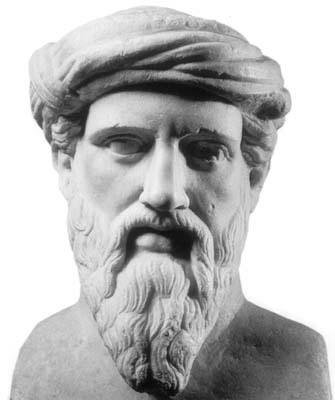
Ancient Greeks: Pythagoras, Mathematics, and Music
 Pythagoras of Samos was a Greek philosopher and mathematician who also founded a mystical relgious movement called Pythagoreanism. He is best known for his Pythagorean theorem which states:
 In any right triangle, the area of the square whose side is the hypotenuse (the side of a right triangle opposite the right angle) is equal to the sum of areas of the squares whose sides are the two legs (i.e. the two sides other than the hypotenuse).
 The truth is, though, Pythagoras may have picked up this proof on his travels to Asia, as this proof was well known among mathematicians there. For more on the Chinese proof, click here.
The Pythagorean School was a secretive society and so many details are not known, but some rules of the Pythagoreans included strict vegetarianism, prescriptions about silence, incense, picking up what had fallen, physical and moral purification, and a belief that "Everything that exists is a number." In around 400 B.C., the discovery of irrational numbers upset the Pythagoreans.
Pythagoras is also famous for his interest in the Music of the Spheres.
 Using a stretched string on a movable bridge, Pythagoras discovered that there were certain intervals that pleased peoples' ears: an octave (1:2), fifth (2:3), and fourth (3:4).
 To listen to what these different intervals sound like, check out Harmony and Proportion. More on musical intervals on the guitar and Pythagoras are here.
For younger kids, print out and read this excellent book chapter on Pythagoras and his followers.
More Resources
Listen to Samples of The Music of Ancient Greece
The History of Music
Pythagoras picture
Subscribe to:
Posts (Atom)