
For logic and rhetoric students, a thorough understanding of the competing ideals, philosphies and plans of today's modernists and postmodernists is essential learning if they want to be able to discuss local and world issues and social and education programs, but there are many more resources available for parents and teachers wanting to share the lessons of antiquity, than lessons of the 20th century.
We've wrestled with this issue as our oldest will be entering his middle school years next year. Here are some of the issues we've wanted to tackle:
1. The blossoming of science and technology and how scientific utopian visions caused trouble in the modern era.
2. Global philosophies and global war.
3. Manipulation of the media for political purposes.
4. The need to see beyond rhetoric behind competing philosophies of human nature, government, and religion.
5. To see how individual heroes (as well as villains) existed in every age, and learn how they met their challenges, where they drew their strength, and how they changed the course of history.
We had been doing Veritas Press cards, but just learning about the Wright Brothers or the Space Shuttle won't do it. It's surprising how poorly middle or high school texts seem to cover the 20th Century, too. We plan to tackle Gileskirk Modernity course next year, but now we're thoroughly enjoying the Teaching Company's course with Vejas Liulevicius on Utopia and Terror in the 20th Century. The audio download ($35) is a steal while it's on sale until mid-May. Highly recommended! The audio download includes lecture outlines, so transcripts aren't needed. Like Professor Fears (Teaching Company Classical History), Professor Liulevicius is an impassioned lecturer who has the knack of identifying essential assumptions and ideas that drove great and villainous leaders and their movements. It's a remarkable story seeing how a vision of a utopian society becomes twisted into a totalitarian nightmare.
In order to make the details of people and places "stick", we've also discovered that making picture flashcards has been invaluable. We'll share them so you can print them out at home. The first lectures have covered changes wrought by the French and Industrial Revolutions, the World Wars, and the ideas and actual realities of the Communist utopia. For additional reading, think about tackling George Orwell's Animal Farm. Because it's an allegory, it may be helpful for some to read this Animal Farm Study Guide ahead of time. Here's an online copy of The Communist Manifesto, too. When we get back from Boston, we'll post more of our links that have been helpful with this course.
Technorati tags: classical education, 20th century, history, homeschooling, modern european history
Wednesday, April 25, 2007


Tuesday, April 24, 2007
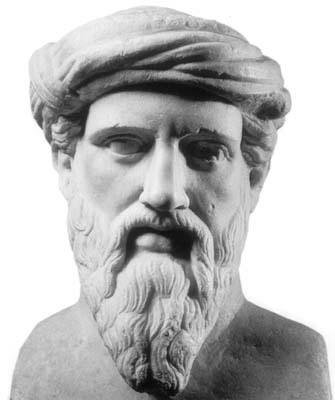
Ancient Greeks: Pythagoras, Mathematics, and Music
 Pythagoras of Samos was a Greek philosopher and mathematician who also founded a mystical relgious movement called Pythagoreanism. He is best known for his Pythagorean theorem which states:
 In any right triangle, the area of the square whose side is the hypotenuse (the side of a right triangle opposite the right angle) is equal to the sum of areas of the squares whose sides are the two legs (i.e. the two sides other than the hypotenuse).
 The truth is, though, Pythagoras may have picked up this proof on his travels to Asia, as this proof was well known among mathematicians there. For more on the Chinese proof, click here.
The Pythagorean School was a secretive society and so many details are not known, but some rules of the Pythagoreans included strict vegetarianism, prescriptions about silence, incense, picking up what had fallen, physical and moral purification, and a belief that "Everything that exists is a number." In around 400 B.C., the discovery of irrational numbers upset the Pythagoreans.
Pythagoras is also famous for his interest in the Music of the Spheres.
 Using a stretched string on a movable bridge, Pythagoras discovered that there were certain intervals that pleased peoples' ears: an octave (1:2), fifth (2:3), and fourth (3:4).
 To listen to what these different intervals sound like, check out Harmony and Proportion. More on musical intervals on the guitar and Pythagoras are here.
For younger kids, print out and read this excellent book chapter on Pythagoras and his followers.
More Resources
Listen to Samples of The Music of Ancient Greece
The History of Music
Pythagoras picture
Monday, April 23, 2007
Ancient Romans: Horatius at the Bridge!
"With weeping and with laughter
Still is the story told,
How well Horatius kept the bridge
In the brave days of old." - Thomas Babbington Macaulay

The story of Horatius Cocles (one-eyed) at the Pons Sublicius bridge (across Tiber River to Rome) is a great one, and Macaulay's Horatius from The Lays of Ancient Rome should be recited aloud (with feeling of course!) after the story read.
There are several versions of Horatius at the Baldwin Project site, but we like this Horatius story best. While most of the men at the bridge fled at the site of the advancing Etruscans, Horatius held his ground and fought courageously, allowing the Romans enough time to destroy all the bridges, saving the city. He lost an eye in the process and dove into the Tiber River. Livy reports he survived and was able to enjoy a statue in his honor from his grateful city.

Technorati tags: classical education, classics,ancient rome, poetry, lessons, homeschooling
Still is the story told,
How well Horatius kept the bridge
In the brave days of old." - Thomas Babbington Macaulay

The story of Horatius Cocles (one-eyed) at the Pons Sublicius bridge (across Tiber River to Rome) is a great one, and Macaulay's Horatius from The Lays of Ancient Rome should be recited aloud (with feeling of course!) after the story read.
There are several versions of Horatius at the Baldwin Project site, but we like this Horatius story best. While most of the men at the bridge fled at the site of the advancing Etruscans, Horatius held his ground and fought courageously, allowing the Romans enough time to destroy all the bridges, saving the city. He lost an eye in the process and dove into the Tiber River. Livy reports he survived and was able to enjoy a statue in his honor from his grateful city.

Technorati tags: classical education, classics,ancient rome, poetry, lessons, homeschooling
Friday, April 20, 2007
What's Your Lifetime Reading List?
In case you haven't seen it, here's Hugh Hewitt's chit chat with David Allen White and John Mark Reynolds about their picks for a Lifetime Book Reading List, or What Every College Freshman and Sophomore Should Read.... For more details, check out the link, but here's my tally of their titles:
The Bible, Shakespeare, Plato's Republic, Dialogues of Plato, The Iliad, The Divine Comedy, Don Quixote, David Copperfield, Brothers Karamazov, Brideshead Revisited,, Gulag Archipelago, The Odyssey, Aristotle's Ethics, Oedipus Rex, Augustine's Confessions, Second Treatise on Government by Locke, The Aeneid, The Gettysburg Address, Lincoln's Second Inaugural Address, Plutarch, History of the English Speaking People, Dicken's A Child's History of England, Birth of the Modern, The Declaration of Independence, The Constitution, The Federalist Papers, Democracy in America, Wealth of Nations, Communist Manifesto, Origin of Species, On the Genealogy of Morals, Civilization and Its Discontents, Abolition of Man, Oresteia,, Summa Theologica, Pascal's Pensees, Pride and Prejudice, Immortal Poems of the English Language, Moby Dick, Essays by Montaigne, Canterbury Tales, The Prince, The Faeire Queene, Calvin's Institutes, Song of Roland, Alice in Wonderland, Through the Looking Glass, Paradise Lost, Boethius' The Consolation of Philosophy, Cicero's On Friendship and On Duties, Hobbes' Leviathan, Anna Karenina, War and Peace, Poems of T.S. Eliot, Witness by Whittaker Chambers, Flannery O'Connor, Mailer's Of a Fire on the Moon, Percy's Lost in the Cosmos.
Many of the classics are available to read online:
Internet Classics Archive
Online Library of Liberty
E-text Catalog at Johnstonia (scroll down)
Malaspina Great Books Curriculum Resources
The Bible, Shakespeare, Plato's Republic, Dialogues of Plato, The Iliad, The Divine Comedy, Don Quixote, David Copperfield, Brothers Karamazov, Brideshead Revisited,, Gulag Archipelago, The Odyssey, Aristotle's Ethics, Oedipus Rex, Augustine's Confessions, Second Treatise on Government by Locke, The Aeneid, The Gettysburg Address, Lincoln's Second Inaugural Address, Plutarch, History of the English Speaking People, Dicken's A Child's History of England, Birth of the Modern, The Declaration of Independence, The Constitution, The Federalist Papers, Democracy in America, Wealth of Nations, Communist Manifesto, Origin of Species, On the Genealogy of Morals, Civilization and Its Discontents, Abolition of Man, Oresteia,, Summa Theologica, Pascal's Pensees, Pride and Prejudice, Immortal Poems of the English Language, Moby Dick, Essays by Montaigne, Canterbury Tales, The Prince, The Faeire Queene, Calvin's Institutes, Song of Roland, Alice in Wonderland, Through the Looking Glass, Paradise Lost, Boethius' The Consolation of Philosophy, Cicero's On Friendship and On Duties, Hobbes' Leviathan, Anna Karenina, War and Peace, Poems of T.S. Eliot, Witness by Whittaker Chambers, Flannery O'Connor, Mailer's Of a Fire on the Moon, Percy's Lost in the Cosmos.
Many of the classics are available to read online:
Internet Classics Archive
Online Library of Liberty
E-text Catalog at Johnstonia (scroll down)
Malaspina Great Books Curriculum Resources
Thursday, April 19, 2007
Really Learning Latin: Vocabulary, Grammar, Translation, and Wheelocks
When we first started learning Latin, we were delighted learn some ancient Roman or Biblical sayings, and delighted to see how quickly we could be up-and-running. But we hit the wall, and soon found what people meant when the said, "You can't REALLY learn Latin without learning the grammar."
For young children, "soft" Latin programs like Minimus, Latina Christiana, or Prima Latina are probably best, but if you think your student would like to some day continue on in Latin at college, then Latin grammar should be tackled as soon as it is developmentally possible.
An example: if a student has only learned vocabulary or famous phrases, she may be perplexed about how to translate a sentence like: Nauta magnam poêtae fâmam nôn laudat. Who's the subject and how do you figure out which noun is which?
Step 1: It's handy to know the most common word order for Latin Sentences:
Subject - subject's modifiers - Indirect Object - Direct Object - Adverbial Words or Phrases - and Verb.
Step 2: Look for the subject and the noun:
Nauta magnam poêtae fâmam nôn laudat.
Step 3: Look at the word endings - and figure out what function the different nouns are serving in the sentence.
Nauta magnAM poêtAE fâmAM nôn laudat.
The AM will tell me that it's fame that's the direct object (The sailor doesn't praise the reputation, not The sailor doesn't praise the poet), or accusative case. The same ending of magnam means it's paired with fâmam (so great reputation, not great poet), and the AE identifies poêtae as genitive (possessive) so it could be translated as "of the poet".
Final translation: The sailor does not praise the great reputation of the poet.
Now, I confess my son and I still run through the chant "a, ae, ae, am, a; ae arum, is, as, is) to jog our memories for the noun endings, but with more practice we wnat to be able see a word ending and know exactly what function (or possibility of functions) that word has in the sentence. Exact grammar terms have to be learned because it allows communicate precisely about word functions to others when questions arise.
There are many resources for Wheelock's Latin on the web. Before we advance to the next chapter, we first do the self check with drills at University of Houston Latin (Scroll down to the Course 1301 drills). Afterwards we can follow up with Dr J's Latin Grammar Explanations or check out Dale Grote's Latin Study Guide if we have any questions.
Additionl Resources for Latin Online Practice that you may find helpful:
University of Victoria Latin Exercises
Latin Wheelock Practice at Quia.com
Wheelocks Audio
Real Latin Inscriptions
For young children, "soft" Latin programs like Minimus, Latina Christiana, or Prima Latina are probably best, but if you think your student would like to some day continue on in Latin at college, then Latin grammar should be tackled as soon as it is developmentally possible.
An example: if a student has only learned vocabulary or famous phrases, she may be perplexed about how to translate a sentence like: Nauta magnam poêtae fâmam nôn laudat. Who's the subject and how do you figure out which noun is which?
Step 1: It's handy to know the most common word order for Latin Sentences:
Subject - subject's modifiers - Indirect Object - Direct Object - Adverbial Words or Phrases - and Verb.
Step 2: Look for the subject and the noun:
Nauta magnam poêtae fâmam nôn laudat.
Step 3: Look at the word endings - and figure out what function the different nouns are serving in the sentence.
Nauta magnAM poêtAE fâmAM nôn laudat.
The AM will tell me that it's fame that's the direct object (The sailor doesn't praise the reputation, not The sailor doesn't praise the poet), or accusative case. The same ending of magnam means it's paired with fâmam (so great reputation, not great poet), and the AE identifies poêtae as genitive (possessive) so it could be translated as "of the poet".
Final translation: The sailor does not praise the great reputation of the poet.
Now, I confess my son and I still run through the chant "a, ae, ae, am, a; ae arum, is, as, is) to jog our memories for the noun endings, but with more practice we wnat to be able see a word ending and know exactly what function (or possibility of functions) that word has in the sentence. Exact grammar terms have to be learned because it allows communicate precisely about word functions to others when questions arise.
There are many resources for Wheelock's Latin on the web. Before we advance to the next chapter, we first do the self check with drills at University of Houston Latin (Scroll down to the Course 1301 drills). Afterwards we can follow up with Dr J's Latin Grammar Explanations or check out Dale Grote's Latin Study Guide if we have any questions.
Additionl Resources for Latin Online Practice that you may find helpful:
University of Victoria Latin Exercises
Latin Wheelock Practice at Quia.com
Wheelocks Audio
Real Latin Inscriptions
Subscribe to:
Posts (Atom)